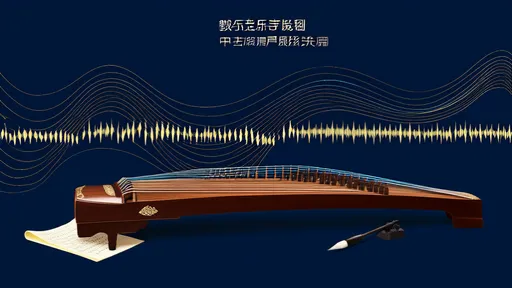
The ancient Chinese guqin, a seven-stringed zither with a history spanning over three millennia, is revered not only for its melodic potential but also for the subtle nuances of its playing techniques. Among these, the yin and nao—vibrato and oscillatory embellishments—stand as pillars of the instrument’s expressive depth. Recent advancements in audio spectral analysis have allowed researchers to deconstruct these techniques with unprecedented precision, revealing a complex interplay of harmonics, temporal modulation, and cultural intent embedded in every note.
At the heart of this investigation lies the guqin’s unique tonal philosophy. Unlike Western instruments that prioritize pitch stability, the guqin embraces controlled instability—a deliberate wavering that mimics the imperfections of nature. Spectral graphs of yin demonstrate a sinusoidal fluctuation in frequency, typically within a 10-30 cent range, while nao exhibits a broader, slower oscillation (50-80 cents) often accompanied by amplitude modulation. These patterns are not random; they follow strict classical prescriptions documented in treatises like the Qinshi Xuanshang, where the speed and width of oscillations are tied to poetic metaphors—comparing yin to "a breeze rippling water" and nao to "a tree swaying in a storm."
What fascinates acousticians is how these techniques alter the instrument’s harmonic profile. Fast Fourier Transform (FFT) analyses of yin-inflected notes show a reinforcement of odd-numbered harmonics (3rd, 5th), creating a "hollow" timbre associated with introspection. In contrast, nao generates sideband frequencies—a phenomenon where modulation produces spectral lines above and below the fundamental frequency—resulting in a "thickened" sound evocative of lament. These findings align with historical accounts linking yin to scholarly refinement and nao to emotional catharsis, suggesting that spectral characteristics were consciously exploited for narrative purposes.
The temporal dimension proves equally revealing. Time-frequency analyses using wavelet transforms uncover how masters like Guan Pinghu layered multiple oscillation rates within a single yin, creating a "vibrato within vibrato" effect. This fractal-like complexity, absent in early 20th-century recordings, implies an evolution of technique—possibly influenced by the qin’s transition from private meditation to concert hall performance. Meanwhile, nao’s slower cycles (0.5-2 Hz) correlate with physiological rhythms like breath or heartbeat, hinting at an embodied cognitive logic behind its expressive power.
Challenges persist in quantifying these phenomena. The guqin’s non-tempered tuning and silk/nylon string variants introduce spectral variables rarely encountered in Western instrument analysis. Researchers at the Chinese Academy of Art have developed adaptive algorithms to account for these factors, isolating technique-specific signatures from material variables. Preliminary results suggest that yin and nao spectra may serve as "acoustic fingerprints" to authenticate historical performance styles or even identify unknown school lineages.
Beyond musicology, these studies resonate with broader discourse on intangible cultural heritage. The spectral "maps" of yin-nao interactions provide a scientific framework to articulate what qin players call yiyun—the ineffable artistic conception. As machine learning models begin to simulate these techniques, they inadvertently highlight what remains irreproducible: the human intentionality behind each microtonal fluctuation, where centuries of scholarly tradition meet the immediacy of a performer’s touch.
Future research may explore cross-modal perceptions—how these spectral patterns trigger synesthetic associations (e.g., "seeing" mountain mist in a yin’s harmonics) or neurophysiological responses. For now, the marriage of ancient artistry and modern acoustics reaffirms the guqin’s status as not merely an instrument, but a cosmology of sound, with every oscillation echoing the Daoist principle of bianhua: perpetual transformation within apparent stillness.
By /Jul 25, 2025
By /Jul 25, 2025

By /Jul 25, 2025

By /Jul 25, 2025
By /Jul 25, 2025

By /Jul 25, 2025

By /Jul 25, 2025

By /Jul 25, 2025

By /Jul 25, 2025

By /Jul 25, 2025
By /Jul 25, 2025

By /Jul 25, 2025
By /Jul 25, 2025

By /Jul 25, 2025

By /Jul 25, 2025
By /Jul 25, 2025
By /Jul 25, 2025

By /Jul 25, 2025

By /Jul 25, 2025

By /Jul 25, 2025
