The concept of structural unity in modern suites represents a fascinating evolution in musical composition, bridging the gap between traditional forms and contemporary experimentation. Unlike their Baroque or Classical predecessors, which often adhered to strict dance movements or thematic development, modern suites embrace a more fluid approach while maintaining an underlying coherence. Composers today weave together disparate elements—tonal and atonal, electronic and acoustic, minimalistic and complex—into a cohesive whole that challenges listeners while rewarding careful attention.
At the heart of this structural unity lies the composer's ability to create invisible threads that bind movements together. These may manifest as recurring motifs, harmonic landscapes, or even meta-narratives that transcend individual sections. For instance, a suite might explore the transformation of a single interval across five movements, each time recontextualizing it within new textures or rhythms. The listener perceives both the variation and the unity, experiencing the satisfaction of recognition alongside the thrill of innovation.
Modern composers frequently employ what might be termed "elastic form"—structures that breathe and adapt while maintaining their essential character. A movement may expand or contract dramatically in duration compared to its companions, yet feel perfectly positioned within the whole. This approach reflects our contemporary understanding of time as non-linear and subjective, allowing suites to mirror the ebb and flow of human consciousness rather than conforming to rigid temporal expectations.
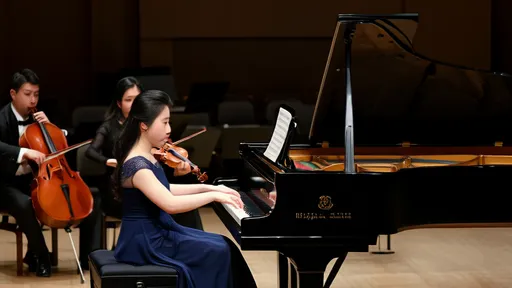
The instrumentation choices in modern suites often serve as another unifying factor. Where traditional suites typically maintained consistent instrumentation throughout, contemporary works might feature radical shifts—from full orchestra to solo electric guitar, from prepared piano to digital soundscapes. Yet through careful timbral relationships or the strategic recurrence of particular instrumental combinations, composers create a sonic fingerprint that makes each suite distinctly itself. The very unpredictability becomes part of the work's identity and structural logic.
Perhaps most intriguing is how modern suites achieve unity through conceptual frameworks rather than purely musical devices. A suite might trace the life cycle of a star, the stages of grief, or the evolution of a city—with each movement representing a different phase while contributing to an overarching intellectual and emotional arc. This programmatic approach, when handled with subtlety, allows for tremendous variety within a clearly defined universe of meaning, satisfying both the analytic mind and the intuitive listener.
The role of silence and space has become increasingly important in binding modern suites together. Strategic pauses between movements, or the use of negative space within them, create a canvas upon which the relationships between sections become clearer. Like the white margins around a series of paintings, these silences frame the musical ideas while allowing them to breathe and resonate across time. Contemporary composers understand that unity often depends as much on what isn't played as what is.
Technology has introduced new possibilities for structural unity that would have been unimaginable to earlier suite composers. Digital processing can transform acoustic sounds gradually across movements, creating imperceptible bridges between seemingly disparate materials. Interactive electronics allow live performers to influence pre-composed elements in ways that maintain coherence while introducing variability. Even the physical placement of speakers in electroacoustic suites can create spatial narratives that unify the listening experience.
As audiences become more musically literate across genres, modern suites increasingly incorporate popular and non-Western elements without sacrificing structural integrity. A movement might transition from post-minimalist patterns to jazz improvisation to microtonal passages, yet feel organically connected through shared rhythmic cells or harmonic suspensions. This cultural fluidity reflects our interconnected world while demonstrating that unity need not stem from stylistic purity.
The most successful modern suites achieve what might be called "fractal unity"—where the relationship between any two movements mirrors the relationship between sections within a movement, which in turn reflects the internal structure of individual phrases. This self-similarity across scales creates a profound sense of rightness, as if every element exists in perfect balance with every other. Listeners may not consciously perceive this architectural perfection, but they feel its emotional impact.
Ultimately, the structural unity of modern suites speaks to our contemporary longing for connection in a fragmented world. These works demonstrate that diversity need not preclude harmony, that innovation can coexist with tradition, and that beneath apparent chaos often lies hidden order. As composers continue to push boundaries while seeking new ways to create coherence, the suite remains one of music's most adaptable and rewarding forms.
By /Jul 25, 2025
By /Jul 25, 2025
By /Jul 25, 2025
By /Jul 25, 2025
By /Jul 25, 2025

By /Jul 25, 2025

By /Jul 25, 2025

By /Jul 25, 2025

By /Jul 25, 2025
By /Jul 25, 2025
By /Jul 25, 2025

By /Jul 25, 2025

By /Jul 25, 2025
By /Jul 25, 2025
By /Jul 25, 2025
By /Jul 25, 2025
By /Jul 25, 2025

By /Jul 25, 2025

By /Jul 25, 2025
By /Jul 25, 2025
