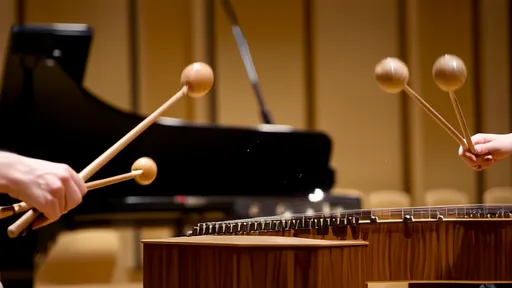
In the grand orchestral landscape, few instruments command as much primal power as the timpani. These massive kettledrums don't merely provide rhythmic foundation—they shape dramatic tension, underscore emotional climaxes, and occasionally shake concert hall foundations. Yet what audiences seldom realize is that nearly half the instrument's magic happens silently between notes, through the refined craft of live tuning.
Modern timpanists operate as equal parts percussionist and pitch alchemist. Unlike most orchestral instruments where tuning happens before performance, timpani require constant pitch adjustments mid-piece to follow harmonic progressions. This creates a unique challenge: changing a drum's pitch by over an octave while maintaining perfect tone quality, all within the space of a few measures' rest.
The Mechanics Behind the Magic
At the heart of live tuning lies the pedal mechanism, a feat of early 20th-century engineering that revolutionized orchestral percussion. When a timpanist depresses the pedal, it either tightens or loosens the entire drumhead simultaneously via a spider-like system of rods and tension rods. High-end models like the Dresden pedal offer micrometer precision, allowing adjustments smaller than a quarter-tone.
Yet hardware alone doesn't guarantee perfect pitch. Professional timpanists develop an almost supernatural ear for the "beating" phenomenon—those audible pulsations that occur when two pitches are nearly but not quite matched. During loud tutti sections, they'll often tune by feeling vibrations through their fingertips rather than relying solely on auditory cues.
Silent Techniques for Noisy Moments
Seasoned players employ ingenious methods for tuning during fortissimo passages when hearing the drum becomes impossible. Some memorize the exact pedal positions for common intervals through muscle memory—knowing that depressing the pedal exactly 1.5 inches will reliably produce a perfect fourth. Others use visual markers, applying discreet tape strips to the pedal's shaft as reference points.
The most theatrical solution involves "pre-tuning" during rests. By striking the drum very softly with a finger while adjusting the pedal, timpanists can check pitch without producing audible sound. This technique, called "ghost noting," requires such precise finger control that the mallet head barely kisses the drumhead.
Temperature: The Invisible Adversary
Concert halls present an ever-shifting battlefield of thermal conditions that wreak havoc on tuning stability. A 10-degree Fahrenheit change can alter a timpani's pitch by nearly a semitone—enough to turn a glorious major chord into painful dissonance. Backstage heaters and air vents become sworn enemies, prompting many timpanists to arrive hours early to acclimate their instruments.
Some players combat this with synthetic drumheads that react less to humidity changes, while purists swear by traditional calfskin for its warmer tone. The true professionals prepare contingency plans, like keeping spare timpani backstage at different temperatures or using portable humidifiers to create microclimates around their instrument station.
The Conductor's Silent Dialogue
An unspoken communication flourishes between principal timpanists and conductors during performance. A raised eyebrow might signal an impending key change, while subtle hand gestures indicate whether to brighten or darken the drum's tone by adjusting stroke placement. The best timpanists anticipate these needs, often preparing alternate tunings before the conductor realizes they're necessary.
This relationship peaks during repertoire with frequent tuning changes, like Strauss's "Also sprach Zarathustra" or Shostakovich's symphonies. In such works, timpanists create elaborate tuning maps—essentially cheat sheets noting every required pitch change alongside measure numbers. Some even color-code these charts by movement for quick visual reference.
When Technology Meets Tradition
While some modernists embrace electronic tuners, most elite timpanists consider them crutches that disrupt musical flow. The delay between checking a tuner and actually playing often proves fatal in fast-paced repertoire. Instead, many develop hybrid techniques—using tuners during rehearsal to verify positions, then relying on muscle memory during performance.
Emerging technologies like piezoelectric pickups offer compromise solutions. These ultra-thin sensors attach discreetly to drum rims, feeding pitch data to wireless earpieces without altering the drum's acoustics. Early adopters report these systems shave crucial seconds off tuning time during complex modulations.
The Zen of the Reset
Perhaps the most underappreciated skill is the "reset"—quickly returning drums to neutral positions after dramatic pitch changes. Like a racecar driver downshifting before a turn, timpanists learn to partially release pedals during final notes of a phrase, allowing springs to assist the return to baseline pitch. Mastery of this technique prevents the telltale "swooping" sound amateur players produce when tuning between notes.
This physical choreography becomes second nature through years of practice. Veteran players can execute four-octave tuning changes across multiple drums while maintaining perfect mallet grip and reading three systems ahead in the score. The result appears effortless, masking what is essentially high-speed mechanical ballet.
As orchestras continue exploring contemporary works with microtonal and aleatoric elements, live timpani tuning evolves from supporting skill to central artistry. The next generation of players pushes boundaries with quarter-tone scales and just-intonation systems, proving that these ancient drums still have new secrets to reveal. Behind every thunderous timpani roll lies this invisible craft—the silent science of making the orchestra's heartbeat stay perfectly in tune.

By /Jul 25, 2025
By /Jul 25, 2025

By /Jul 25, 2025

By /Jul 25, 2025

By /Jul 25, 2025

By /Jul 25, 2025

By /Jul 25, 2025

By /Jul 25, 2025

By /Jul 25, 2025

By /Jul 25, 2025
By /Jul 25, 2025

By /Jul 25, 2025

By /Jul 25, 2025

By /Jul 25, 2025

By /Jul 25, 2025

By /Jul 25, 2025

By /Jul 25, 2025

By /Jul 25, 2025

By /Jul 25, 2025
By /Jul 25, 2025
